One of the first questions people ask when they start thinking about trademark registration is how much it actually costs. And it’s a fair question, because the answer isn’t as simple as a single number.
The trademark cost in 2026 depends on several factors: how you file, how many classes of goods or services you register under, whether issues come up during the process, and what it costs to keep the registration active over time.
This guide breaks down every cost involved, from the initial filing fee to trademark renewal fees, so you know exactly what to budget for before you start.
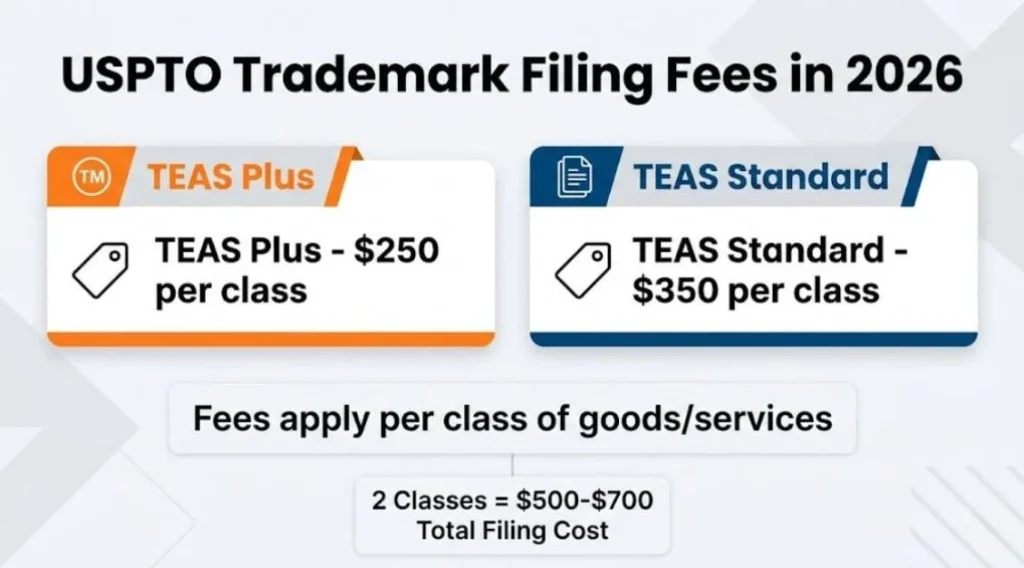
All trademark applications in the United States are filed through the USPTO using their online TEAS system. The filing fee depends on which application type you choose.
| Application Type | Fee Per Class | Best For |
| TEAS Plus | $250 | Applicants using pre-approved descriptions from USPTO ID Manual |
| TEAS Standard | $350 | Applicants who need to write a custom description of goods/services |
These trademark filing fees are per class of goods or services. If your trademark covers products in two different classes, you pay the filing fee twice. A clothing brand filing under Class 25 (clothing) and Class 35 (retail services) would pay either $500 or $700, depending on which form they use.
The USPTO organizes all goods and services into 45 classes. Each class covers a specific category of products or services. You register your trademark in the classes that are relevant to your business.
| Class | Category | Examples |
| Class 9 | Electronics and software | Apps, tech devices, computer software |
| Class 25 | Clothing and apparel | Shirts, shoes, hats, accessories |
| Class 35 | Business and retail services | Online retail, advertising, business consulting |
| Class 41 | Education and entertainment | Online courses, publishing, events |
| Class 43 | Food and beverage services | Restaurants, cafes, catering |
Filing in more classes means broader protection but higher upfront costs. Most small businesses and startups start with one or two classes and expand later as the brand grows.
The USPTO filing fee is just the starting point. Several other potential costs may arise during and after the application process.
Before filing, a thorough trademark search is strongly recommended. Filing without searching first risks rejection based on an existing similar mark, which means losing your trademark filing fees and starting over.
• Basic USPTO database search — free using the USPTO’s TESS system
• Professional trademark search — typically $300 to $800, depending on the scope
• Comprehensive clearance search through an attorney — $500 to $1,500 or more
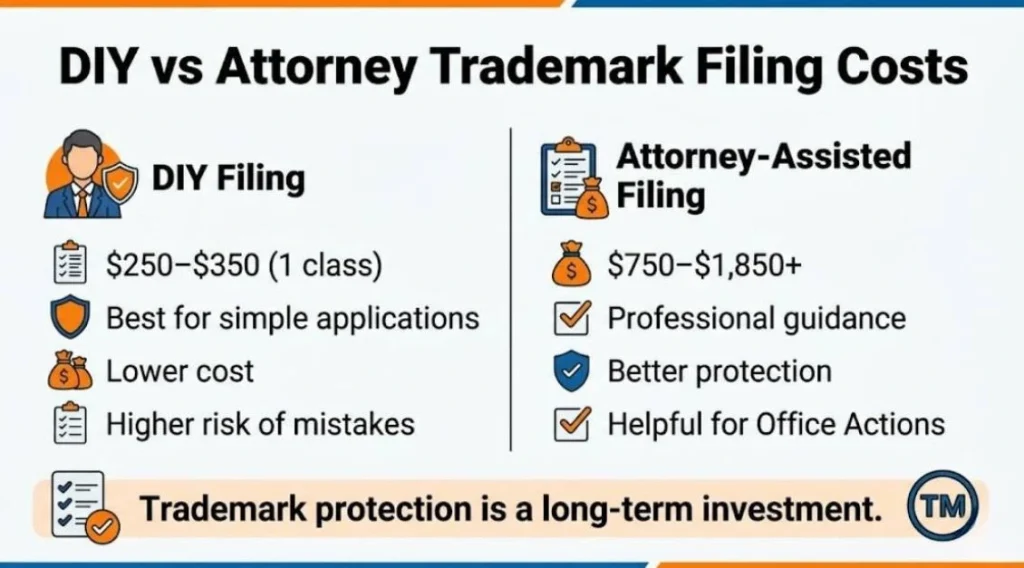
You can file a trademark yourself, but many applicants choose to work with a trademark attorney, especially for complex applications or when legal refusals are likely.
| Service | Typical Cost Range |
| Trademark search | $300 to $800 |
| Application preparation and filing | $500 to $1,500 |
| Responding to an Office Action | $500 to $2,000+ |
| TTAB opposition proceeding | $3,000 to $10,000+ |
| Full registration with attorney support | $1,000 to $3,000 total |
If the USPTO examiner raises issues with your application, you’ll receive an Office Action requiring a formal response. If you’re handling it yourself, there’s no additional USPTO fee for the response. If you hire an attorney, their fees apply. Complex refusals involving likelihood of confusion or descriptiveness arguments can require significant legal work.
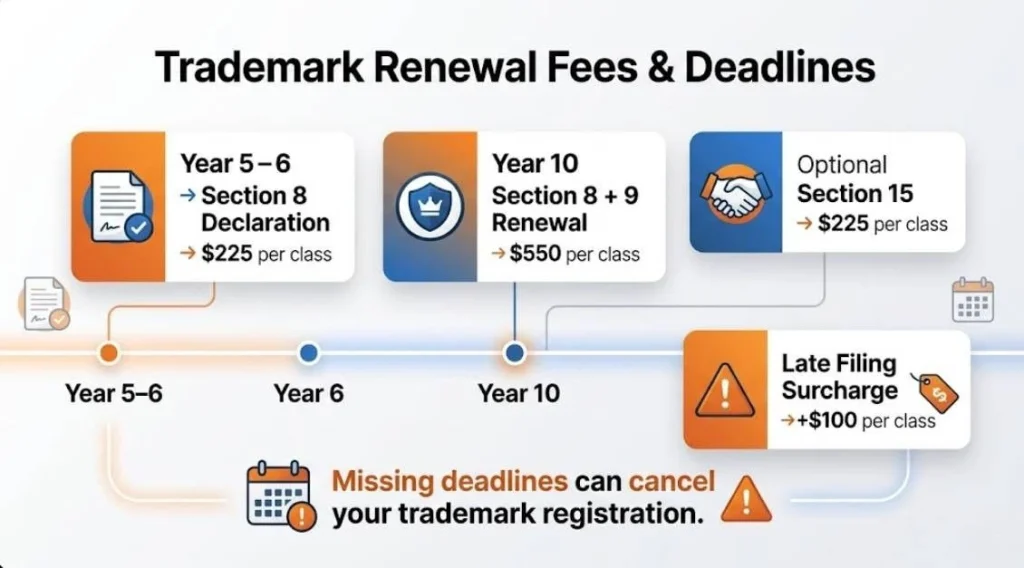
A registered trademark doesn’t last forever without maintenance. The USPTO requires regular filings to keep a registration active. Missing these deadlines results in the cancellation of the registration.
| Filing | When Due | USPTO Fee |
| Section 8 Declaration | Between years 5 and 6 after registration | $225 per class (TEAS) |
| Section 9 Renewal | Every 10 years from registration date | $325 per class (TEAS) |
| Combined Section 8 and 9 | At the 10-year mark | $550 per class (TEAS) |
| Section 15 Declaration (optional) | After 5 years of continuous use | $225 per class |
| Late filing surcharge | Within 6-month grace period | Within a 6-month grace period |
These trademark renewal fees are per class. A trademark registered in two classes would cost $450 for a Section 8 Declaration or $650 for a combined Section 8 and 9 filing at the 10-year mark using the TEAS system.
The Section 15 Declaration is optional but highly valuable. Filing it after five years of continuous use achieves incontestable status for the trademark, which significantly limits the grounds on which others can challenge it. The $225 per class fee is modest compared to the long-term legal protection it provides.
| Scenario | Approximate Total Cost |
| DIY filing, one class, no issues | $250 to $350 |
| DIY filing, two classes, no issues | $500 to $700 |
| Attorney-assisted filing, one class | $750 to $1,850 |
| Attorney-assisted filing with Office Action response | $1,500 to $3,500+ |
| Full 10-year maintenance (one class, DIY) | $800 to $1,000 total over 10 years |
| Full 10-year maintenance (one class, with attorney) | $1,500 to $3,000+ over 10 years |
A USPTO registration only covers the United States. If your business operates internationally or plans to, separate filings are needed for other markets.
| Filing Option | Coverage | Approximate Cost |
| USPTO only | United States | $250 to $350 per class |
| Madrid Protocol (WIPO) | 130+ countries via one application | $653+ base fee, varies by country |
| EU Trademark (EUIPO) | All EU member states | Approximately 1,000 euros for one class |
| Individual country filings | Specific countries | Varies significantly by country |
The biggest variables in total trademark cost are:
• Number of classes filed — each additional class multiplies every fee
• Whether an Office Action is issued — responding adds time and cost
• Whether you use an attorney adds high cost but reduces the risk of rejection
• International scope — each additional territory adds filing fees
• Maintenance compliance — missing renewal deadlines adds surcharge fees or requires refilling
Trademark registration in 2026 starts at $250 for a single class DIY filing and can grow significantly depending on how many classes you need, whether complications arise, and how much professional support you involve.
The smartest approach for most businesses is to treat trademark costs as a long-term investment rather than a one-time expense. The initial filing is just the beginning. Budgeting for renewals, maintenance filings, and potential enforcement costs from the start means you won’t be caught off guard down the road.
A brand worth building is a brand worth protecting. And the cost of protecting it is almost always lower than the cost of losing it.
USPTO filing fees start at $250 per class for TEAS Plus applications and $350 per class for TEAS Standard. Most small businesses file in one or two classes. Attorney fees, if used, are separate from these government fees.
Trademark renewal fees include a Section 8 Declaration due between years five and six ($225 per class) and a Section 9 Renewal due every ten years ($325 per class). Combined filings at the ten-year mark cost $550 per class. Missing deadlines results in cancellation or additional surcharge fees.
Yes. The USPTO allows self-filing through their online TEAS system. For straightforward applications with no complications, DIY filing is entirely manageable. Applications with complex descriptions, likelihood of confusion issues, or Office Actions benefit significantly from professional guidance.
For a single-class trademark, the minimum USPTO maintenance cost over ten years is approximately $550 for the combined Section 8 and 9 filing. Adding optional Section 15 incontestability brings it to $775. Attorney fees for managing these filings add to the total.
There is a six-month grace period after the official deadline during which you can still file with a $100 per class surcharge. If you miss the grace period entirely, your trademark registration is cancelled, and you would need to file a new application, losing the original registration date and priority.
